Impact of AI on CRM Systems
The experiment underscores the substantial impact of artificial intelligence (AI) techniques on Customer Relationship Management (CRM) systems, particularly in analyzing customer reviews. By leveraging advanced AI models such as CNN-LSTM, businesses can gain deeper insights into customer sentiment, enabling them to understand and respond to customer needs more effectively. The results demonstrate the model's capability to accurately classify sentiments, providing actionable data to improve customer satisfaction and tailor services strategically. This not only validates the model's effectiveness but also highlights its practical value and potential in real-world CRM applications.
1 Experiment Overview
This experiment utilizes a hybrid model combining Convolutional Neural Networks (CNN) and Long Short-Term Memory (LSTM) networks to analyze customer review texts from "Jiji Hong Hotpot Chain". The aim is to extract sentiment tendencies from customer reviews, providing direct indicators of customer satisfaction for the company and supporting data-driven service improvement strategies.
1.1 Experiment Process
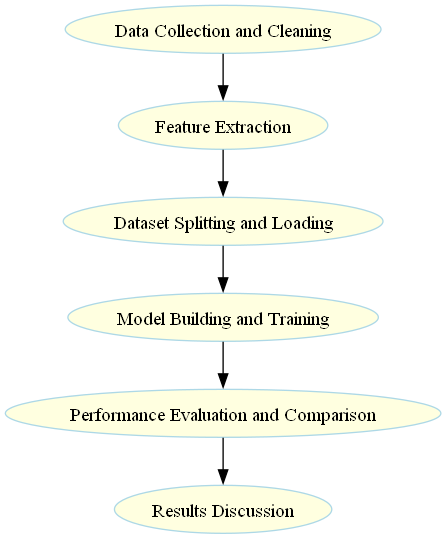
The experiment follows a comprehensive process to handle, analyze, and interpret customer review data. The main steps include:
- Data Collection and Preprocessing: Collecting over 10,000 customer reviews, followed by cleaning, tokenization, synonym replacement, and sentiment annotation.
- Sentiment Label Extraction and Preprocessing: Initial sentiment classification using natural language processing tools, with manual review and label correction to ensure accuracy.
- Feature Extraction: Using NLP techniques like BERT for text feature extraction, converting text into word vectors to capture deep semantic information.
- Data Loading and Splitting: Designing a data loader for handling large datasets and splitting data into training, validation, and test sets.
- Model Construction and Training: Building a CNN-LSTM hybrid neural network model and training it on the prepared dataset. Comparing its performance with standalone CNN, LSTM, and other baseline models.
- Performance Evaluation and Comparison: Evaluating model performance using metrics such as accuracy, recall, precision, specificity, and F1 score. Analyzing performance changes before and after hyperparameter tuning to find the optimal model configuration.
- Result Discussion: Discussing the application potential and advantages of the CNN-LSTM model in sentiment analysis, providing insights into the experimental results and practical application scenarios.
1.2 Experiment Files Record
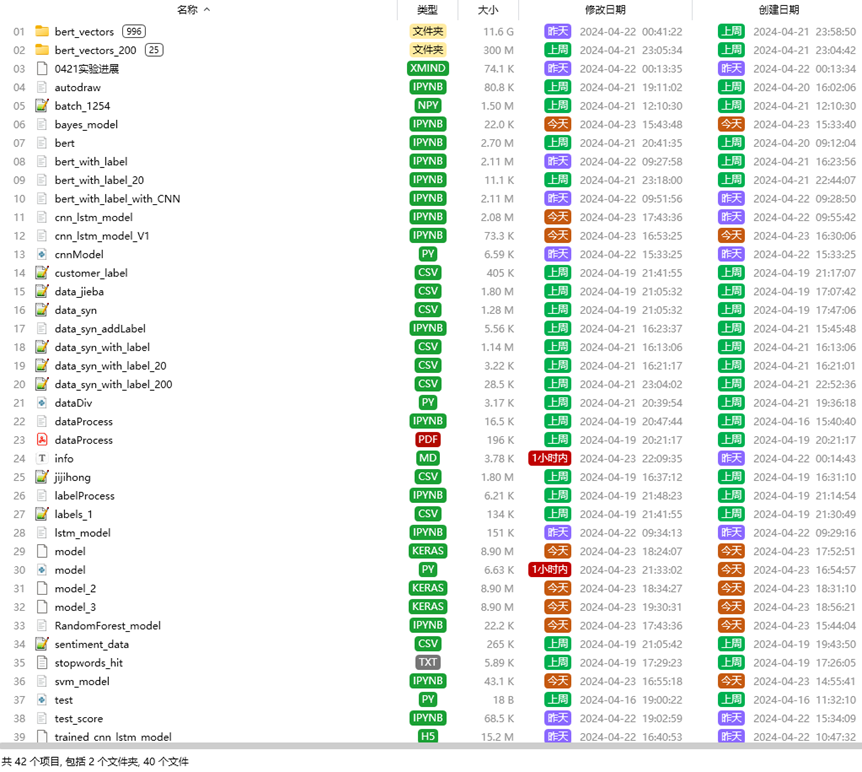
All generated data files and models are meticulously recorded and saved, ensuring the reproducibility of the experiment. These files include:
- Data Files: CSV and npy formats for storing processed text data and word vector representations.
- Code Files: Python scripts (.py) and Jupyter Notebook files (.ipynb) containing the complete code for data processing, model training, and evaluation.
- Model Files: HDF5 (.h5) and Keras (.keras) formats for storing trained models, useful for loading, further training, or prediction.
To facilitate future research and improvements, experimental flowcharts and other documents are also saved. Most of the data, excluding large files, are uploaded to Gitee and GitHub platforms for reference and use by other researchers.
2 Model Tuning Results
The constructed CNN-LSTM model underwent a series of training and validation phases, demonstrating its effectiveness as a sentiment analysis tool on the test set. Performance tuning revealed significant stages, as shown in Table 5.1.
| Model | Accuracy | Recall | Precision | Specificity | F1 Score |
|---|---|---|---|---|---|
| Initial Model | 0.9147 | 0.1545 | 0.8947 | 0.9982 | 0.2636 |
| Model_1 | 0.9321 | 0.6182 | 0.68 | 0.9706 | 0.6476 |
| Model_2 | 0.9321 | 0.4545 | 0.7813 | 0.9821 | 0.5747 |
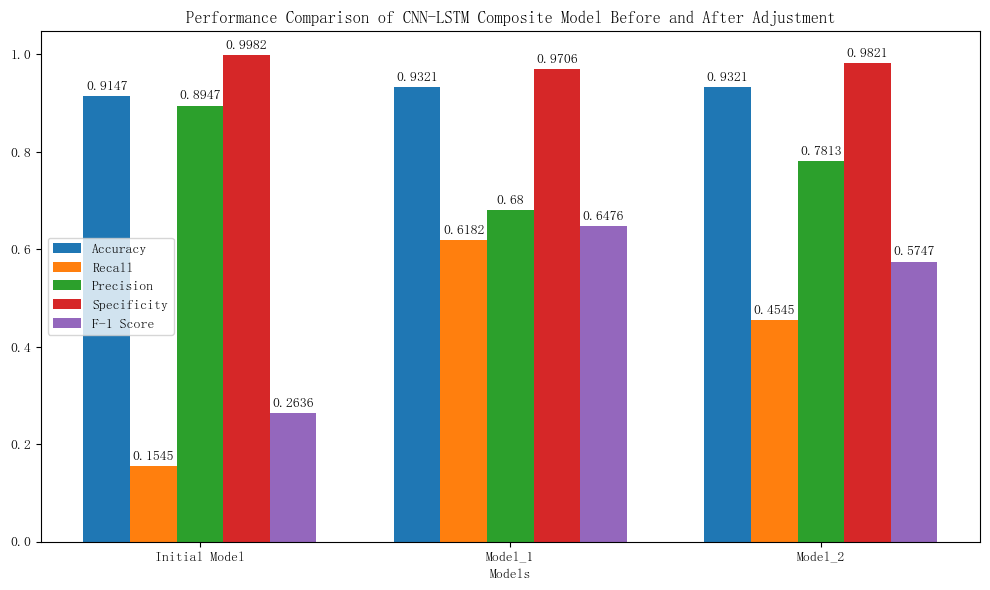
Initial model, despite high accuracy, showed low recall, indicating insufficiency in identifying negative sentiments. Model_1, during tuning, showed improvements in recall and F1 score, enhancing positive sentiment recognition. However, there was room for further optimization. Model_2, after meticulous hyperparameter adjustments, exhibited outstanding performance with significant improvements in precision and F1 score, balancing high accuracy and effective negative feedback capture.